
Understanding Slab-on-Grade Foundations: What Homeowners Need to Know
Updated: Mar 7
The Basics of Slab-on-Grade Foundations
Slab-on-grade foundations are one of the most common types of foundations used in residential construction. They consist of a single, continuous concrete slab poured directly on the ground. This slab is reinforced with steel and designed to support the entire structure above it. Homeowners often prefer slab-on-grade foundations because they are cost-effective, quick to build, energy-efficient, and well-suited for many climates.
However, while concrete is strong, durable, and long-lasting, it is not indestructible. Since the slabs rest directly on soil, they are closely tied to what happens beneath them. Changes in moisture, soil movement, and temperature can directly influence how the slab behaves over time. Cracks might be the first sign that something is amiss.
Now, cracks are not a sign that concrete has ‘failed.’ In fact, cracking is part of the concrete’s natural life cycle. The questions you need to ask yourself are: “What kind of crack is this? What might’ve caused it?”

Understanding Concrete Behavior
Understanding the behavior of concrete will give you a clearer picture of what to expect. With that in mind, let’s talk about pouring and curing.
When concrete is poured, it is a mixture of cement, water, and aggregates that hardens through a chemical process called hydration. During curing, the concrete loses moisture and shrinks slightly while internal stress begins to form.
Now, the shrinkage is completely normal. If the slab is restrained by soil friction, reinforcement, or nearby structures, the stress needs somewhere to go. More often than not, it releases itself in the form of cracks. So, cracking at this stage is expected.
Common Causes of Concrete Cracks
Let’s explore some of the common causes of concrete cracks:
Shrinkage: As mentioned earlier, this occurs during the curing process. As concrete cures and dries, it shrinks. If it can’t move freely, it cracks. The result of this is:
Hairline cracks
Spiderweb or map-like patterns
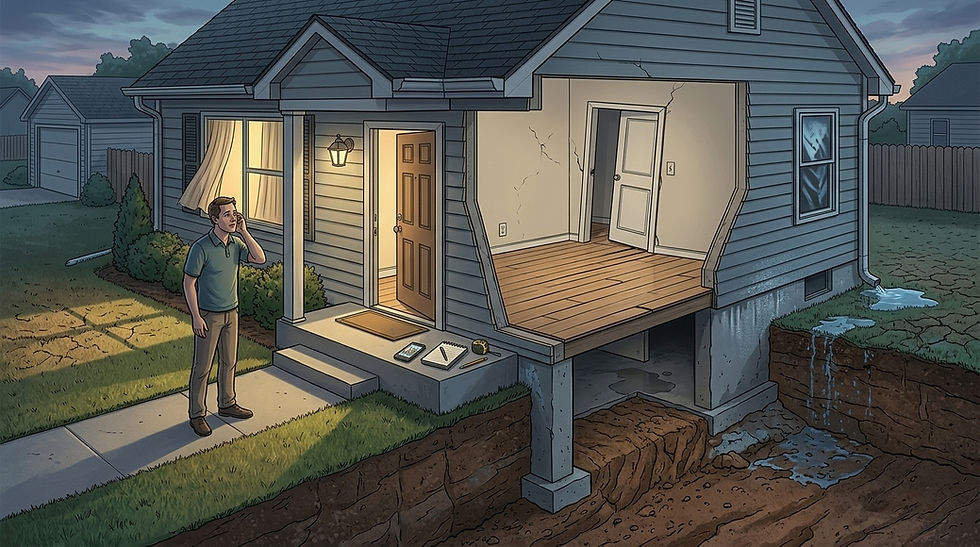
Soil Movement: Concrete slabs rest directly on the soil beneath them. When the soil beneath a slab moves, the slab has no choice but to respond. In physics terms, it’s a bit like Newton’s third law: the ground applies force, and the structure reacts. The problem is that concrete doesn’t react evenly. It’s strong under compression but weak in tension. Instead of bending, it relieves stress by cracking.
Remember that the soil can compress, shrink if it dries out, or expand if moistened. It can even wash away due to poor drainage. As a result, you might see:
Wider cracks
Uneven or offset edges
Cracks that change over time
Temperature Changes: Like most materials, concrete expands when heated and contracts when cold. Repeated temperature cycles create stress, especially in large slabs. You might notice:
Straight cracks running across slabs
Cracks near edges or corners
Cracks that open and close seasonally
Improper Joint Placement: Or no joints at all, for that matter. Control joints are intentional weak spots designed to manage inevitable cracking and tell concrete where to crack. Best practices require them to be cut to a depth of 1/4 of the slab thickness and within 6 to 18 hours of pouring, while spaced between 4 to 12 feet apart. If the joints are:
Too far apart
Too shallow
Missing entirely
Overloading or Point Loads: Another common cause of cracking is overloading the concrete beyond its strength capacity. Heavy loads, such as vehicles, large appliances, or structural additions, can overstress areas not designed to carry that weight. This can result in:
Cracks radiating from load points
Corner cracking
Settlement-related fractures
These usually appear within the first weeks or months and are often cosmetic. They will not affect structural performance.
This is where concrete overlaps with foundation movement.
This is exactly why control joints exist. They guide where cracks form, making them essential for durability.
Then the slab will decide for itself, resulting in random cracking patterns and long straight cracks across open areas.
Types of Concrete Cracks
Now, let’s take a look at the different types of concrete cracks you might encounter:
Hairline Cracks
Hairline cracks are very thin (less than 3mm wide) and are typically nothing to worry about. They are usually shrinkage-related and common in new slabs. Often referred to as cosmetic in nature, they can be sealed and monitored. However, wider cracks may require professional inspection to determine the cause and appropriate repairs.
Settlement Cracks
Settlement cracks are usually caused by the soil under the concrete settling or compressing over time. They are typically wider at the top and narrower at the bottom, forming a ‘V’ shape. While smaller settlement cracks pose no danger, larger ones may require structural repairs.
Drying Shrinkage Cracks
As discussed above, drying shrinkage cracks happen naturally in irregular shapes or patterns. They are usually superficial. Keeping concrete moist as it cures can help minimize them.
Restraint Cracks
These occur when concrete is restrained from shrinking freely while it dries. They often appear in straight, regular lines.
Vertical Cracks
Vertical cracks are often related to shrinkage or minor settlement. They are usually of less concern if stable, so it’s a good idea to monitor them over time.
Diagonal Cracks
Diagonal cracks are often associated with uneven movement. They are common near corners or openings and may indicate differential movement.
Horizontal Cracks
Horizontal cracks are less common in slabs but more serious in walls. They are often linked to lateral pressure and usually warrant professional evaluation.
Offset or Uneven Cracks
Offset or uneven cracks indicate that one side is higher than the other. This suggests movement beneath the slab and is a structural concern.
Freeze-Thaw Damage
This type of damage is particularly relevant in areas with cold climates. A freeze-thaw cycle is an environmental process where temperatures fluctuate above and below freezing. This causes water trapped in materials to freeze, expand by 9%, and then melt. This repeated expansion and contraction can lead to damage. In the case of concrete, water in cracks and pores can create stress and enlarge cracks upon freezing. These cracks tend to be wider at the surface and narrower as they go deeper. Waterproofing and sealing concrete can help prevent this damage.
Prevention and Maintenance
Next time, we will explore the different things you can do to prevent serious risks derived from cracks in concrete slabs. We’ll also provide a guide on what you can handle yourself.
Remember, cracks are not automatically bad news. However, if you are worried about cracks, don’t hesitate to give us a call. At iFix, we don’t just look at cracks; we look at what caused them. Soil conditions, moisture, drainage, load paths, and foundation behavior all matter. If you’re unsure about what you’re seeing, a professional assessment can bring clarity and peace of mind before small issues turn into larger ones.
For more information on foundation repair and maintenance, check out our services here.


Comments