
‘Best’ Foundation Repair methods Explained
Among the things that great cinema action heroes have taught us is that every hero has their signature move or signature gadget: a whip and a fedora, a web-shooter, a laser sword or an Aston Martin with a few optional extras installed. Different tools, different situations, different methods.
Foundation repair works much the same way.

The right tools for the right job.
Many homeowners assume that there is one universal (or best) way to fix a foundation problem, but there is a reason why there are several repair methods available and each one is designed to solve a specific issue. The best solution will always depend on the home’s design, the type of soil beneath it, the nature of the movement and the reason of that movement.
Today’s mission is to familiarize you with some of the most common foundation methods in plain English.
The first thing we need to clear up is that there is no ‘Best’ repair.
One of the biggest misconceptions we encounter is the idea that one repair method is superior to them all. But the truth is that the best repair method will depend on how suitable it is for the problem it’s trying to solve.
Think of it like this: using the Mjolnir to tighten a screw doesn’t make the Mjolnir a bad tool. It just means you’re using it for the wrong job. This very same logic applies to foundation repair.
A proper inspection should identify not only ‘what’ is moving but ‘why’, before recommending any solution.
Slab-on-Grade Homes
Many homes in the DFW Metroplex are built on slab-on-grade foundations: a large concrete slab poured directly over prepared soil.
More often than not, when a homeowner notices cracks, sticking doors or uneven floors, they imagine that the entire slab myst be replaced, but fortunately that is rarely the case. In many situations, the objective is simply to stabilize the affected area and prevent further movement by
addressing the underlying causes.
And depending on the diagnosis, this may involve installing support systems beneath the foundation, correcting drainage problems, managing soil moisture, or combining several approaches to restore long-term stability. It’s less of jacking up a house and more like restoring balance beneath it.
That’s why two homes with seemingly similar cracks may end up receiving completely different recommendations. The symptoms might look alike, but the causes underneath can be very different.
Pier-and-Beam Homes
Homes built on pier-and-beam foundations work differently. Instead of resting on one continuous slab, the floor system is supported by beams, joists and piers, creating a crawlspace beneath the house.
Over time, natural settling, wood movement or changing soil conditions can affect these support points. Some common symptoms include:
- Floors that feel bouncy or sagging.
- Doors that suddenly stop latching correctly.
- Gaps appearing around trim or baseboards.
- Uneven areas when walking through the home.
Depending on the diagnosis, repairs may involve reinforcing or adjusting the existing support system by adding supplemental supports or correcting areas that have shifted. But because every crawlspace is different, the solution is tailored to the conditions found underneath the home rather than following a one-size-fits-all approach.
Deep Foundation Solutions: Helical Piers and Push Piers
I think that if there is one word from the world of foundation repair that is most recognized everywhere is ‘pier’.
Sometimes the soil near the surface can no longer provide reliable support and when that happens, it may be recommended to transfer the home's weight deeper into more stable ground using piers.
The two most common types are helical piers and push piers.
Helical Piers
A helical pier is essentially a steel shaft fitted with spiral plates that allow it to be screwed into the ground, almost like an oversized screw (oversized Mjolnir not included).
Installation continues until the pier reaches soil capable of supporting the required load.
Helical piers are often selected when:
- Surface soils are unstable.
- Controlled installation is important.
- Access for heavy equipment is limited.
- Additional support is needed beneath specific areas.
You can think of it as anchoring into solid ground instead of relying on weaker soil near the surface.
Push Piers
Similar in purpose, Push piers reach stable soil differently. Instead of being screwed into the ground, they are hydraulically driven downward using the weight of the structure itself. Once they reach sufficient resistance, they become a new support point for the foundation.
They’re commonly used when:
- A structure has already experienced settlement.
- The building is heavy enough to provide the driving force.
Long-term stabilization is needed.
Going back to our opening premise about which system is better, the real answer is that the best option will depend entirely on the engineering requirements of that specific project.
Here’s the funny thing: sometimes the best repair isn’t even under the house. This, of course, might surprise many homeowners as sometimes the solution isn’t adding steel or concrete at all.
Foundation movement is frequently driven by water management issues, meaning the most effective corrective action may involve additional services and/or preventive measures like:
- Improving drainage.
- Regrading the landscape.
- Extending downspouts farther from the home.
- Maintaining more consistent soil moisture.
- Repairing plumbing leaks.
- Adjusting irrigation practices.
Addressing the cause is often just as important as stabilizing the structure itself.
The best part is that there are plenty of preventive steps that homeowners can take:
- Monitor cracks over time.
- Keep gutters free of debris.
- Extend downspouts away from the foundation.
- Maintain consistent moisture around the home.
- Watch for standing water after storms.
- Photograph and document any changes.
Simple habits that can help identify problems before they become larger and more expensive.
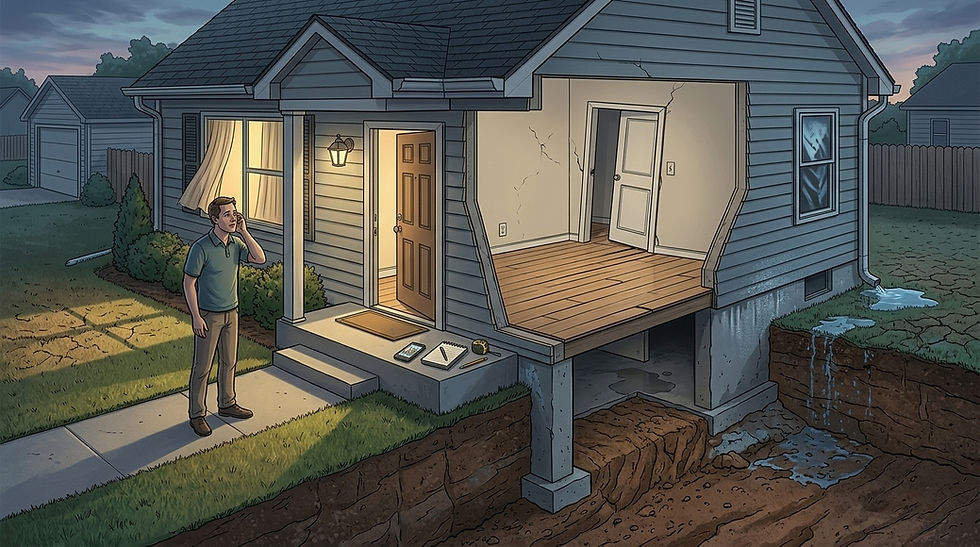
Of course, there’s only so much homeowners can do themselves, so if you notice any of these it’s time to call an expert and schedule a professional inspection:
- Cracks that continue widening.
- Doors or windows that no longer operate properly.
- Floors becoming noticeably uneven.
- Persistent moisture or drainage problems.
- Multiple warning signs appearing together.
At iFix, understanding always comes before repairs. Every home has its own history, soil conditions, drainage patterns and structural needs. That’s why every recommendation starts with a thorough inspection. The goal is to identify the root cause of the movement and recommend the approach that makes the most sense for your home. Remember the right repair is the one your home actually needs.


Comments