
Good Drainage vs Bad Drainage
One of the trickiest things about drainage problems is that they rarely announce themselves dramatically at first. No sudden floods or cinematic pipes bursting through the walls. No set pieces or money shots.
Quite the opposite in fact. Most of the time, drainage problems begin quietly. Puddles that overstay their welcome, soil washing slowly away, mulch shifting in the rain or water collecting where it shouldn’t. Instead, it is all about the small clues. But like any good detective knows, the signs start to make sense once you know where to look. Or what to look for.
This is why drainage matters so much. As we’ve discussed before; water is one of the biggest causes of foundation movement. If there’s too much moisture it expands the soil, if there’s to little it causes shrinkage. But drainage will be your first line of defense as it determines where the moisture goes and how long it stays there.
A good drainage will maintain stable soil conditions, controlled moisture levels, and will reduce erosion, helping keep a consistent support beneath the home.
But bad drainage will do the opposite.
Elementary, my dear homeowner. Or should I say elemental?

But what does good drainage look like? Funnily enough good drainage is often quite easy to miss and this is because nothing dramatic happens. Or nothing seems to happen and that is exactly what we have to aim for.
After rain water should always flow away from the home, disperse gradually, absorb evenly into the soil and disappear in a reasonable amount of time.
We’ve mentioned before how useful it is to walk around your home after rain. Keeps you active, lets you enjoy the freshness in the air, and gives you that unmistakable smell of petrichor drifting through the yard. But more importantly, it allows you to see what’s working (and what isn’t) around your home.
Walking after the rain is over will let you verify of your drainage is working properly. Sings of a healthy drainage include:
Water flowing away from the foundation.
Ground sloping gently away from the home, rather than toward it.
No standing water.
Puddles disappearing relatively quickly after the rain.
Soil staying consistent.
No erosion, washout areas or exposed roots.
Gutters and downspouts working properly.
Mulch still in its place
Flowerbeds not washing out.
Crawlspaces and Basements staying dry.
No persistent dampness or musty odors.
Good drainage goes unnoticed because the system is quietly doing its job. Kind of like when you do something right and nobody notices? Exactly like that.
And just like that, when you do something wrong everyone notices. So, what does bad drainage looks like?
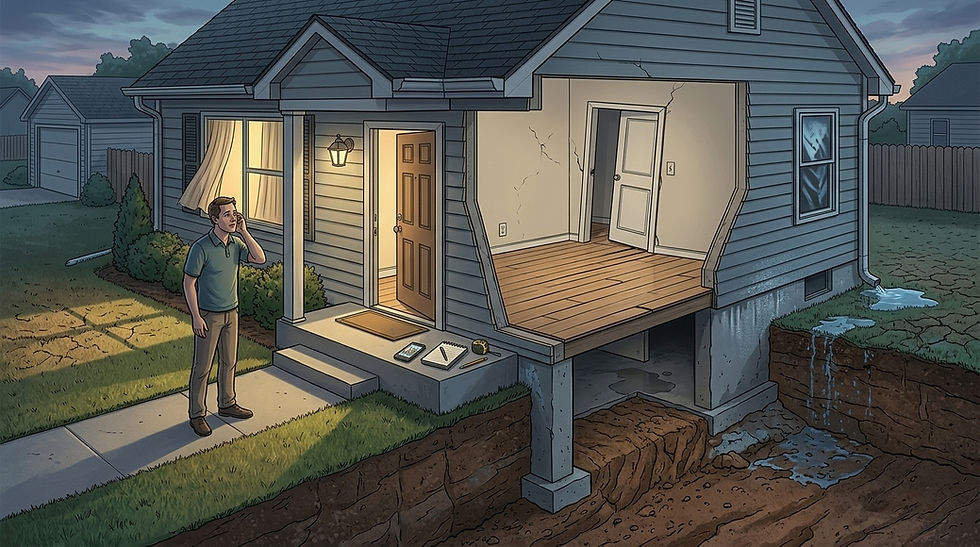
When you know what to look for, bad drainage signs will be all over the place.
Standing water will be one of the clearest warning signs. And if water sits near the home long after rain stops, moisture is likely accumulating where it shouldn’t.
This can lead to over-saturation of the soil, increase hydrostatic pressure, and create uneven expansion beneath the foundation.
This is how you can look for each of these signs:
Erosion and Soil Washout
Moving water carries soil with it. To identify if this is happening you have to look for exposed roots,
trenches or channels in the yard, soil pulling away from the foundation and mulch constantly being displaced after storms.
If the soil is leaving, then the support for the foundation might be leaving as well.
Downspouts dumping water too close.
This is incredibly common and we actually see it everyday on the job. Even if you have a perfectly functional gutter system, it can still create problems if the downspouts discharge water right beside the house.
Over time, the concentrated water in one area will create uneven moisture conditions
Water Flowing Toward the Home
Sometimes the grading around a property unintentionally slopes inward. To verify this check if water is moving toward the slab, if there is pooling near the walls or if there are muddy edges around the home.
You might think that a subtle slope will not have much bearing on this, but overtime they also matter.
Not all signs are outside, tho. Check inside to see if there are damp or musty areas indoors. Moisture indoors can also take different shapes, so look for musty smells, damp crawlspaces,
mold growth, condensation and warped materials.
Don’t forget to check on cracks that, that like all good movie monsters, keep returning. If they repeatedly appear after after repairs, inconsistent soil moisture may still be active underneath. In many occasions the problem is that drainage issues were never fully resolved.
Remember that healthy drainage does not mean that your soil has to be completely dry all the time with no moisture. It is about controlling where the water goes, and this should always be: away from home, evenly distributed and without prolonged saturation.
The good news about all this is that many drainage problems are highly manageable once identified early.
At iFix, we know that a good result does not come form only inspecting foundations, but evaluating the entire water-management system surrounding your home. Drainage patterns, grading, runoff, moisture conditions, and soil behavior all help explain why movement happens and how to prevent it long-term. And for this we have a whole lot of preventive actions and additional services to help keep your home and foundation safe before anything happens.


Comments