
PLOT TWIST: IT MIGHT NOT BE YOUR FOUNDATION
You know the scene.
After many twists and turns the clues finally point towards one suspect; for two hours the evidence has been piling up and finally the detective is about to make the accusation. Yeah, we are sure the mystery has been solved. And then the last ten minutes happen. Then the final plot twist: whoever we've been accusing for the past two hours didn't do it. And the real culprit was hiding right under our noses.
Now, in our best Benoit Blanc impression: “Houses can pull the same trick, you know?”
(Please tell me you read that with a Southern drawl.)
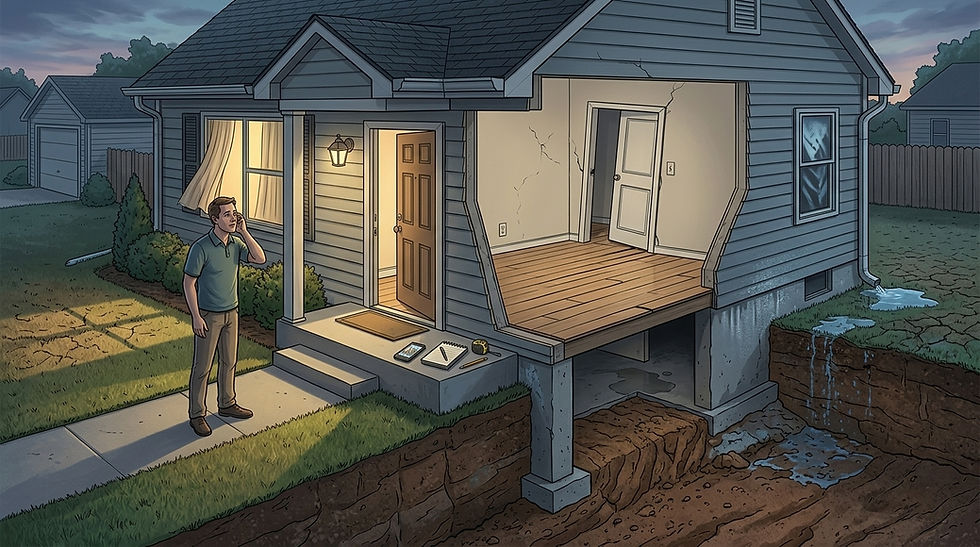
A crack appears on a wall, a door suddenly sticks, the floor feels a little uneven, there is moisture where there shouldn't be moisture. You know, the usual suspects. The ones we’ve accused (and rightly so) of being guilty by association with foundation problems.
But sometimes, just sometimes, the foundation has an airtight alibi.
That is one of the reasons why diagnosing a home based on a single symptom can be misleading. Why? Well, because many of the signs commonly associated with foundation movement can also be caused by many other factors, like changes in materials, moisture, framing, plumbing, flooring, drainage or even simple wear and tear.
However, we are not suggesting that those symptoms should be ignored. Quite the opposite. It simply means that before deciding what needs to be repaired, we first need to understand what is actually causing the problem.

So grab your metaphorical magnifying glass, and let’s start questioning the suspects.
SUSPECT 01. “A Crack in the Case: It must be the foundation!”
Poor cracks. The celebrity villains of foundation repair. We see a crack and immediately imagine the slab shifting beneath our feet. But as we have discussed before, cracks can appear for a number of reasons.
Concrete shrinks as it cures. Drywall joints can move slightly. Wood framing expands and contracts. Temperature and humidity change throughout the year. Even previous repairs may age or separate.
So, a crack, by itself, doesn't always tell us very much. What matters is the story around it. You know, the motive.
Where is the crack? How wide is it? Which direction does it travel? Has it changed? Is it getting longer? Does it keep returning after being repaired? Are there additional cracks nearby? Are doors beginning to stick or floors becoming uneven at the same time?
By now the crack may be asking for a lawyer. That's fine. We're not after a confession; we're after context.
A tiny drywall crack that has looked exactly the same for ten years tells a very different story from a crack that appeared six months ago and has steadily grown while other symptoms develop around it.
So, the crack is evidence and not automatically the culprit.
SUSPECT 02. “The Door That Wouldn’t Close: The house must be moving!”
A sticking door is another classic foundation symptom, because indeed, changes in a foundation can affect door frames. But before blaming several thousand square feet of concrete, perhaps check the hinge for instance, as there are plenty of ordinary reasons why a door can become difficult: wood can swell when humidity increases, hinges can loosen, doors can warp, frames can shift slightly, paint can build up around the edges and hardware can wear out. Sometimes a simple fix will do the trick.
The important question becomes whether the sticking door is an isolated problem or part of a larger pattern. One stubborn bathroom door is no problem. Several doors and windows suddenly becoming difficult to operate while new cracks appear nearby, then all of a sudden the plot thickens. Like with anything else, context changes everything.
SUSPECT 03. “Vertigo! The Floor Is Uneven! The foundation is sinking!”
An uneven floor certainly deserves attention, but even here there can be more than one possible cause. In a pier-and-beam home, for example, what feels like foundation movement might involve part of the floor system itself.
Joists can deteriorate, beams can become damaged, moisture affects wood, supports beneath the floor can shift or deteriorate, previous remodeling may have changed how loads are distributed, even flooring materials themselves can create the appearance or sensation of unevenness if they were poorly installed or laid over an imperfect subfloor.
That is why simply standing in a room and thinking, “Yep, that feels crooked,” isn't quite enough to diagnose what is happening. So get your metaphorical F-CSI (Foundation Crime Scene Investigation) kit and start measuring, look for patterns and understand where movement occurs.
Sometimes the foundation really is moving and other times the problem is sitting directly above it.
SUSPECT 04. “The Trouble With Water: My foundation is failing.”
Water and foundations have a complicated relationship. We have talked plenty about how moisture affects soil, particularly in clay-heavy regions like North Texas. Too much water can contribute to soil expansion, erosion and drainage problems. Too little can cause soil to dry and contract.
But finding water near or inside the house does not automatically mean the foundation itself has failed. The moisture may be coming from somewhere else; plumbing leaks, roof leaks, poor grading, irrigation problems, HVAC condensation, overflowing gutters and improper downspouts and crawlspace humidity can be the culprits hiding in plain sight and the foundation may simply be the place where you notice the symptom. Kind of like being in the wrong place at the wrong time.
So water near the foundation might just be another clue, and not the crime itself.
Before reaching for a structural solution, we need to know where that water is coming from and where it is going.
SUSPECT 05. “Rear Window! The gap that raises suspicions!”
Gaps around windows, trim, cabinetry or walls can sometimes accompany structural movement, but houses are built from many different materials, and those materials don't all behave the same way.
Wood reacts to humidity, caulk shrinks and ages, trim can separate, cabinetry can shift slightly, windows and doors can develop installation or hardware issues. Also, take into account that time waits for no man, nor material for that matter.
The question isn't simply whether a gap exists. The questions that need to be addressed are: how recently did it appear? Is it changing? Does it return after being repaired? (you know what they say about culprits returning to the crime scene). Are similar gaps developing elsewhere? Are there other signs of movement nearby?
It all builds up a case. A single tiny gap may simply be a cosmetic maintenance issue, while several widening gaps appearing alongside cracks and uneven floors deserve considerably more attention.
SUSPECT 06. “What Lies Beneath: My floor feels bouncy!”
Particularly relevant in pier-and-beam homes. A bouncy or sagging floor can certainly be associated with support problems, but that doesn't necessarily mean the entire foundation is moving. The issue could involve beams, joists, individual supports or moisture-related deterioration beneath the floor.
A crawlspace is a system of interconnected structural components and if, for instance, one beam is damaged or a support isn't functioning properly, the symptoms may feel dramatic inside the house even though the problem is relatively localized underneath. This is why crawlspace inspections can be so important.
What feels like one thing from above may look very different once you actually see what is happening below.
WRONG SUSPECT: “The Foundation was the real victim, and not the villain!”
Here is where things become especially interesting. Sometimes there genuinely is foundation movement, but the foundation itself is not where the problem began.
Remember the system we've talked about throughout this blog:
Water → soil → foundation → structure.
A drainage problem changes moisture conditions. The soil responds. The foundation reacts to the soil. The structure reacts to the foundation.
By the time a crack appears inside the house, several things may already have happened before the foundation ever entered the story. For example, a downspout repeatedly dumping stormwater next to one corner of the house may keep that area considerably wetter than the soil on the opposite side. That means the soil responds differently. Then the foundation responds differently and then the symptom appears inside.
In that situation, repairing only the visible symptom without addressing the water problem may be like arresting the getaway driver while letting the mastermind walk away. The foundation may be involved, yes, but it may not be the beginning of the story.
This is where homeowners sometimes become understandably frustrated. With no specialized detective/foundation inspector training, how do you know what you’re looking at?
If a crack can mean foundation movement or normal material behavior… And if a sticking door can mean foundation movement or humidity… and if uneven flooring can mean foundation movement or a floor-system problem...
...how are you supposed to know what is happening?
While you don't have to diagnose everything yourself you can still collect incredibly useful information. Ask yourself these basic questions:
What changed? Did something appear suddenly, or has it existed for years? Where is it happening? Is the problem isolated to one room, one wall or one side of the house? When does it happen? Does it become worse during summer droughts? After heavy rain? During humid weather? Is it changing? Is the crack getting wider? Is the floor becoming more uneven? Are doors getting harder to operate? What else is happening nearby?
Remember that the more information about symptoms you have the clearer the picture will become. And like any detective worth his or her salt knows; photographs, notes, measurements and dates are extremely valuable. One symptom gives you a suspect. Several related symptoms give you a case. Changes over time give you evidence.
Don’t panic, and don’t dismiss. As Inspector Clouseau once put it, “I suspect everyone, and I suspect no one.” The best foundation diagnoses don't begin with a repair method. They begin with questions: understand first. Repair second.
At iFix, we are all about understanding what your home is actually doing. We look at the symptoms, but we also look beyond them: soil conditions, drainage, moisture, structural movement, crawlspaces, landscaping and how all of those things interact with one another.
Sometimes that investigation will lead to foundation repair (and you already have the best at the crime scene), but sometimes drainage or moisture management makes more sense. And sometimes the best recommendation will be to simply monitor what you're seeing and keep an eye on it.
Because before you repair the suspect, it helps to make sure you've got the right one. Plot twist and all.


Comments