
WHEN YOUR HOME TALKS, DO YOU LISTEN?
Houses make noises.
Things go bump in the night. The wood creaks, the floor pops, the walls may crack and ajar doors chill the spine when they creak. And every once in a while you discover a mysterious damp spot somewhere and wonder how long that has been there.
Now, before you call the Warrens, there is probably a much less supernatural explanation. And no, the damp spot surely isn't the result of any shenanigans from the Canterville Ghost.
What is happening is simply your home reacting to the environment around it. Temperature changes, humidity, rain and drought cycles, soil movement, materials expanding and contracting, etc. Most of the time these reactions are perfectly normal. But sometimes…(dun… dun… dun!!) they're not.
Trying to make your house completely silent or perfectly still is neither achievable nor desirable. The important thing is learning its language because knowing what it's saying can help you distinguish between the normal sounds and movements of a living structure and the early signs of something that deserves attention.
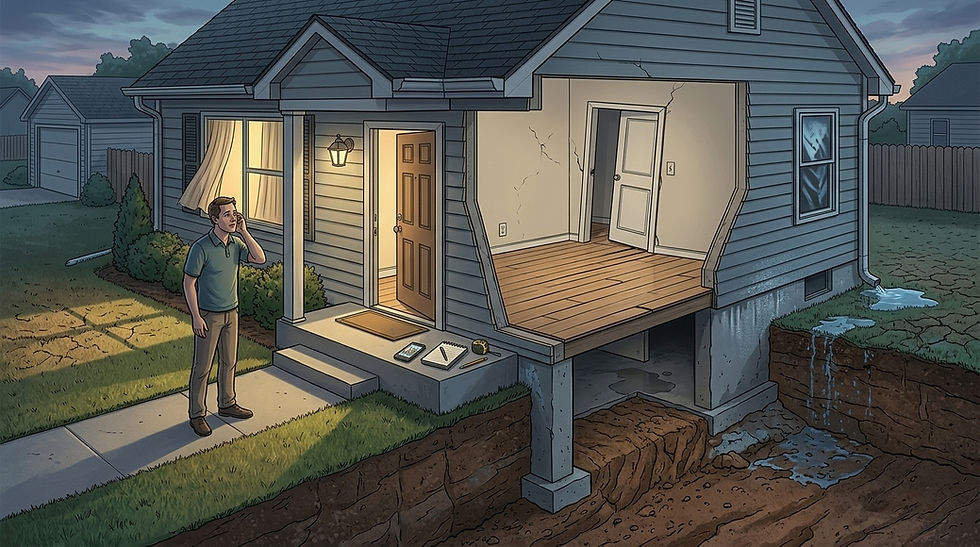
Let’s begin with the most literal way your house “talks."
There are many reasons for this, and most of them are perfectly mundane. Wood naturally expands and contracts with temperature and humidity changes, while framing materials move slightly. HVAC systems heat and cool and the floors respond to the weight of people walking across them. So creaks and pops here and there don’t automatically mean structural problems.Once again, what matters here is change: when a floor creaks for years it is telling a different story than the one that suddenly begins making new noises while feeling softer, bouncier or uneven. So you have to be always on the look-out to spot these changes. Pay special attention whenever:
A new sound appears suddenly
Creaking becomes noticeably worse
Floors begin sequeaking in new areas
Sounds are now accompanied by visible movement or gaps
A floor begins to feel bouncy or sagging.
However, we are not going to limit ourselves to hearing, but instead we will put most of our senses to good use.
Let’s say you’ve heard your house talk; now it is time to look:
Cracks have become something of a recurrent cast member in this blog; making frequent appearances and for good reason.
Matierals shrink and houses settle; therefore cracks appear. This can happen on concrete or drywall alike. One or two cracks don’t automatically mean the foundation is failing; but patterns can reveal a whole other story to you.
Look at where they are, how wide they are and the direction that they travel. Have they changed? If you repair it, does it come back to haunt you? Do they come alone, or are they accompanied by sticking doors, uneven floors and even more cracks nearby?
A small, stable cosmetic crack may require little more than monitoring, or a DIY cosmetic repair like we've shown you before.
But if a crack grows, changes or comes along with other symptoms then that is a whole other story.
Hear. Look. And now… feel.
Houses move and that is normal. Soil is not static; it reacts to the environment around it so it is only natural that a foundation that rests on soil, moves. Particularly in clay-heavy areas, this is a phenomenon that is particularly noticeable. Clay absorbs and contracts depending on the amount of water around it (the giant sponge we’ve talked about before).
Rainy periods can increase soil moisture and expansion. Hot, dry summers can cause soil to shrink. Seasonal temperature and moisture changes create a natural cycle beneath the home.
Now, most houses (at least those that have been well-designed) are built to tolerate a certain amount of this movement. Think of it, loosely, like a palm tree. If it were completely rigid or still, the wind would make it snap in two. But if it is a little flexible… well, it can stand wind or movement a lot more easily. The same principle applies to your home: a certain amount of movement can be accommodated. So the goal is not stillness, but balance.
There is, however, a limit to this. So, when does movement become abnormal? There is an important distinction to be made between movement that is minor and relatively consistent and movement that becomes uneven, excessive or progressive and the way to differentiate this is by paying attention to things like:
- One section of the floor becoming noticeably lower than another.
- Doors or windows suddenly becoming difficult to operate.
- Gaps developing between walls, ceilings, trim or cabinetry.
- Cracks becoming wider or longer.
- Several symptoms appearing in the same area.
Worsening over time.
This is particularly important with differential movement, where one portion of the foundation moves differently from another.
You've heard. You've looked. You've felt. Now, smell. Yes, smell too is important as moisture has something (or more like a lot) to say too.
A persistent musty odor in a crawlspace, basement or room may indicate excessive moisture. So can condensation, damp materials, mold, standing water or areas of soil that remain unusually wet. Always be on the lookout for any of these signs. And don't forget to look outside too, especially after heavy rain:
- Standing water near the foundation.
- Downspouts dumping water beside the house.
- Erosion or soil washout.
- Soil pulling away from the foundation during drought.
- Areas that remain significantly wetter or drier than others.
Water flowing toward the house instead of away from it.
Always remember that your yard is part of the same system as the foundation. Contrary to that popular saying what happens outside doesn’t stay outside as it can, and will, eventually influence what happens underneath.
Observing how these changes behave through the seasons is just as important, because sometimes when a symptom appears tells you almost as much as the symptom itself.Doors might be harder to close during the summer, or a crack becomes more noticeable during prolonged droughts. Timing matters as it can tell you more about the nature of the problems, based on how the patterns react to the environmental changes.
This is why documentation matters. Taking notes and pictures with dates and measurements is like keeping a medical record of your home. It will help diagnose and treat whatever problems may arise in the future
When you pay attention to what your house has to say by listening, looking, smelling and feeling, you begin to understand its normal behavior. And once you know your home's baseline, it becomes much easier to recognize when something changes.
At iFix, that's exactly what we do during an inspection. We don't go around prescribing repairs for every crack we see. We listen. We take in everything the house is telling us: soil conditions, drainage, moisture, structural movement, crawlspaces, landscaping and the patterns your home has developed over time.
That helps us determine whether what you're seeing is simply normal seasonal behavior, whether some maintenance or water-management improvements may be enough, or whether your house really is calling for help.
So the next time your house creaks in the middle of the night, listen, as it might actually have something useful to tell you.


Comments