
The Silent Signs of Foundation Problems
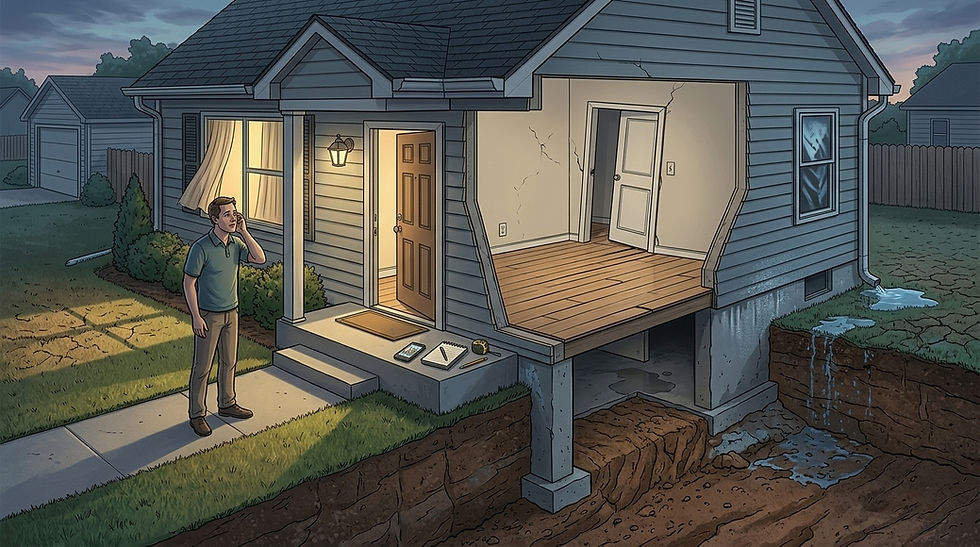
There’s a moment in many great stories when something feels… off. The best plot twists don’t come out of nowhere; they’re built on small clues that were there all along. You just didn’t notice them the first time. Homes are not that different. Before major foundation problems reveal themselves through large cracks or visible damage, they often leave behind subtle clues. Quiet, easy-to-miss signs, not enough to act on. A door that doesn’t close quite the same way it used to, or a sound that wasn’t there before.

These things are not invisible, but the challenge is that sometimes they are so small that they’re easy to dismiss. Today we want to show you how to identify these signs; not for you to be ready for the plot twist, but for you to stop the plot twist from ever happening altogether.
Remember that foundation movement is gradual. It doesn’t happen overnight, as it is the result of different elements like soil expansion and contraction, moisture changes or drainage issues. And this is exactly why the earlier warnings tend to be small.
But catching them on time can mean simpler fixes and less of an impact on your home (and wallet).
Among the earliest signs to look out for are:
Doors.
Most of the time when we think of a door as a sign of foundation problems we think about doors that stuck whenever we try to open or close them. But the real trick is not letting it get to that point. You have to pay attention whenever something feels different about a door. It doesn’t get stuck, but off.
Something is slightly different; maybe it used to close smoothly, but now you need to push it slightly. Maybe the latch no longer lines up as well as it used to. Or maybe now the door swings open or closed off on its own.
All of these can signal slight shifts in the frame, and more often than not it is one of the earliest signs of movement in the foundation.
Windows.
Much like doors if the windows start resisting; sticking when opening, or feeling tighter than usual or even no longer sitting flush when closed, it might be a reflection of shifts in the structure around them.
Hairline cracks.
Not all cracks are a problem (We’ve even taught you how to fix hairline cracks yourself). It is pattern’s you should be looking out for:
Thin cracks near corners of windows or doors, small vertical or diagonal lines in drywall. Some of them may be cosmetic, but the patterns over time can tell a different story.
Gaps.
Where there used to be none. The natural lines of your home should always stay consistent. And when changes in these lines happen, they happen gradually, which is why they are easy to overlook.
So whenever you find one of the following, you should closely monitor them over time: small separations between walls and ceilings, gaps above door frames or baseboards pulling slightly away from the walls.
Floors.
While it may not be as dramatically or showy as in walls and ceilings, the floor also tells a story. Catching subtle differences in time, like it feeling uneven in certain spots, a faint bounce where it used to feel solid or a marble that slowly rolls in one direction, can make a whole lot of difference as these are early indicators of uneven support beneath the structure.
Nail pops or Drywall Imperfections.
Small, round bumps or cracks where nails or screws push through drywall. It is important to remember that these can happen naturally, but again patterns matter. If they appear along other signs, they may be signaling movement.
Changes After Weather Shifts.
One of the most important clues is ‘when’. When the symptoms appear is just as important as the symptoms themselves. If doors stick more during hot, dry months, or if the cracks become visible after heavy rain or if the floors feel different from season to season.
Of course, one sign alone doesn’t necessarily mean you have a serious foundation problem. But if multiple signs are appearing together, or changing over time, then it deserves attention.
So if you are noticing any of these, you should do the following:
- Take photos and date them
- Monitor changes over time
- Check if symptoms worsen with weather
- Walk around your home (inside and out) regularly
As you can see, you don’t even need special tools. You just need to be consistent so you can figure out the patterns (if there are any).
Of course there are times when calling an expert is needed. Sometimes the signs are no longer subtle and they are raising the alarm bells at loud, so if you have any of the following:
- Signs are increasing or spreading
. Doors/windows stop functioning properly
- Floors feel noticeably uneven
- Cracks grow wider or longer over time
- Multiple symptoms appear together
… it is time to get a diagnosis from an expert.
A good plot twist may be surprising the first time around, but those signs that have been peppered through the movie before it comes, makes it feel genuine and not like something just happening out of the blue.
So pay attention to those signs. Spot what is coming and act accordingly. These signs, these symptoms, may not seem like much individually. but together they can be the early signs of something shifting beneath your home.
At iFix, we believe homeowners shouldn’t have to guess what those signs mean. Our inspections go beyond surface symptoms, looking at the full picture to give you clear, honest answers and long-lasting results.


Comments