
🎶Summer Nights🎶 Season-by-Season Tips to Keep Your DFW Foundation Strong
Every season has its charms. Today we will go into the final part of our season-by-season tips trilogy and talk about summer, which happens to be the season we tend to look forward the most. With the summer solstice days are longer and the skies are bright. Then there’s the all-American backyard cookouts or breaks near a pool under some shade.

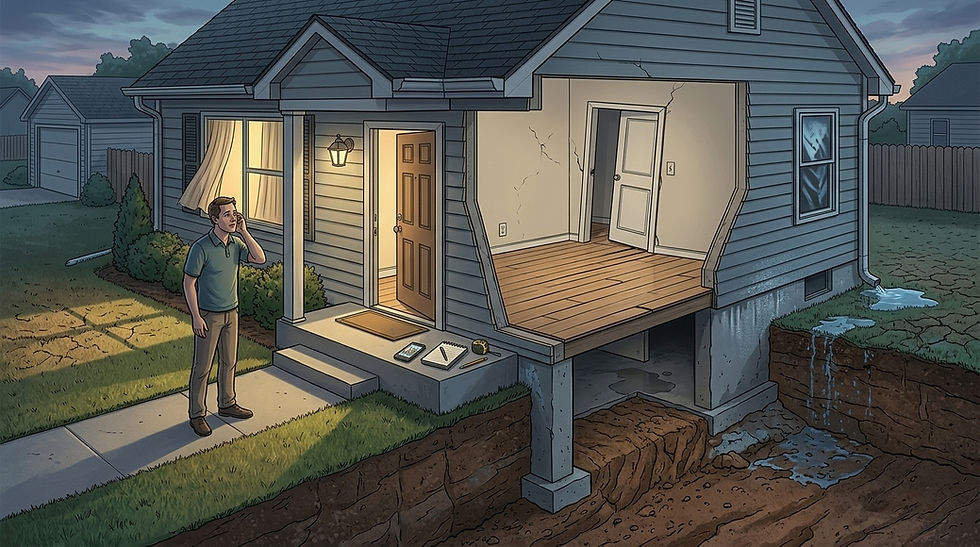
But as much as summer brings warmth and life, it also brings one of the biggest stress tests for your foundation. As the temperature rises, moisture tends to disappear. And when moisture disappears… what happens to the soil? All together now… the soil begins to move.
Yes, we’ve stablished before that changes in moisture, whether the excess or lack of it, cause the soil to change shape, which in turns brings about movement. Movement that directly impacts your foundation.
But what exactly does Summer heat does to your foundation? Well, in regions like DFW (and many others with clay-heavy soils for that matter) summer causes the soil to:
Dry out, shrink, pull away from the foundation and create voids beneath slab
and this can lead to:
Settlement, cracking and ending up with uneven supports.
One of the easier ways to visualize this is by comparing your foundation to a table. Your foundation depends on the soil beneath it for support. And when that soil shrinks because moisture is now gone, it is like removing pieces from under a table, little by little, until eventually, something shifts.
What are the warning sings to look out for during the summer (or hot months in general)?
- New cracks forming in walls or floors
- Existing cracks widening
- Doors and windows sticking
- Gaps forming between walls and ceilings
Soil pulling away from the foundation perimeter
Most of these changes can be very subtle at first, however it us during summer time that they tend to start or accelerate.
Let’s now get into our summer maintenance checklist:
Maintain Consistent Soil Moisture
This is the most important one. The big one. The main attraction, sort to speak. The most efficient way to counteract soil shrinking is to keep a certain degree of moisture at all times.
So, you will have to lightly water the soil around your foundation during extended dry periods, however it is just as important to avoid overwatering.
The trick here is consistency. This will always be more important than quantity.
And while at first it may sound rather difficult to know exactly when you’ve reached the desired degree of moisture, the good news is that this balance can be achieved quite easily:
Something as simple as a soaker hose system will help you with even distribution over extended periods of time. You can get it running manually, or you can even buy a timer to set up the time of day and the amount of minutes you want the water to be running. Some models even have wi-fi capability which allows them to track the weather, and act in response to this: if rain is expected then the soaker hose will not run, saving you both money and avoiding over-saturation. Other tools like soil moisture-meters are a great help.
(In case you are interested, we have a detailed post going over the functionality and installation process for soaker hoses)
Remember, with moisture, as with the force, the trick is balance, not saturation.
Check for Soil Separation
Once more, walking around the home is a very useful thing to do: check for gaps between the soil and the foundation, look for any signs of cracked or hardened soil and if you see separation, that’s a sign that the soil has shrunk and may no longer be supporting the slab properly.
Inspect and Adjust Irrigation Systems
This one is quite easy to adjust when needed. When talking about irrigation systems like sprinklers, it is essential to make sure of two things: first is making sure sprinklers are not hitting the foundation directly. The second one is to ensure even coverage around the house.
Also, make sure to fix any leaks or broken sprinkler heads it could bring about expansion in the areas affected in the leaks, which could lead to further movement.
Watch Trees and Roots
Trees love summer and they have a tendency to compete aggressively for water. And as beautiful as it is to have a treen near your home, it can prove to be a bit of an inconvenience if they happen to sit too close to your foundation. Large trees near your home can draw moisture from the soil beneath your foundation, specially during dry seasons when moisture is more scarce.
This can create localized drying which can lead to differential movement. It can also bring about direct damage if the roots hit your foundation (or utility lines for that matter).
Now, let’s not get ahead of ourselves. You don’t need to remove the trees around your house, just be aware of their impact and act accordingly. The tips about moisture and irrigation systems will come in handy when a tree stands near your house, and other services like root barriers can also make quite a difference.
Check for Early Cracks
Summer is also the perfect time to document cracks, measure changes and take photos. This will help you compare any potential changes that might not be noticeable at first glance as some of these movements tend to be quite gradual.
However if you stumble upon rapid crack growth, noticeable sloping floors, persistent soil separation and multiple symptoms appearing together then it’s time to get a professional evaluation.
At iFix, we understand how seasonal changes affect the soil beneath your home. Our approach looks beyond the surface, evaluating moisture patterns, drainage, and structural behavior to identify the real cause of movement.
If your home is showing signs of stress during the hotter months, we can help you understand what’s happening and recommend solutions that keep your foundation stable, not just today, but through every season.


Comments