
THE REPAIR IS DONE… NOW WHAT?
The villain has been defeated and the hero walks into the sunset. The music swells, and credits begin to roll.
And with that half the audience immediately gets up and leaves.
Rookie. Mistake.

Everyone is well aware by now that you have to stay through the credits, because, most of the time there is one more scene left. One final stinger. And in many ways foundation repair can be just like that.
The structural work is finished, the equipment has been packed and the crew has gone home, leaving the piers installed and the affected areas stabilized and the structural work complete.
However your home’s story doesn't necessarily end the moment the last repair is completed and the last hole has been patched up. And knowing what to expect after foundation repair can be just as important as understanding the repair itself.
You always have to keep in mind that a foundation repair is an intervention and not a time machine. No matter how good the contractor is, nobody is installing a flux capacitor beneath your house, to take the house back to its younger days before any problems started showing up.
So, having said that, let’s talk about what might come next.
“Will All the Cracks Disappear?”
This is probably one of the first expectations worth clearing up. Foundation repair addresses structural movement and support. It does not automatically erase every cosmetic symptom that movement may have created over time.
Drywall cracks may still be visible and brick or mortar cracks may remain. Not to mention paint damage and trims that may have separated, caulk joints might also need attention.
While the structural problem and the cosmetic evidence of this are related, they are not the same thing however. Once the foundation has been stabilized, some cosmetic repairs may still need to be handled separately.
And in some cases, waiting before making those repairs may make sense so you can see how the house responds after stabilization.
The important thing is not whether every crack vanishes after the repair, but whether the structure is performing as intended and the symptoms remain stable.
“Will My Doors and Windows Work Perfectly Again?”
Maybe, but not necessarily.
Doors and windows are often affected by movement because their frames depend on the surrounding structure staying properly aligned. After foundation repair, some of them may improve considerably, while others may still need adjustments.
Sometimes it’s just a hinge that needs adjustment, but other times a frame may have developed a slight permanent distortion over time. And this where expectations matter. The repair can address the issues beneath the house but it will not magically reset every component above to factory settings, so sometimes a little finish work might still be required.
“So the House Goes Back Exactly Where It Was?”
Remember we mentioned the time-machine? Foundation repair is generally about stabilization and, where appropriate, controlled correction and not about sending the house back to the precise position it occupied the day it was built.Time waits for no man. Or house for that matter. Homes change over time as materials age, as framing settles and floors wear. Add remodeling on top of that and sometimes the changes all these bring along aren’t completely reversible.
The goal of the repair is not to return every component of the house to some hypothetical factory-new position. That would be an unrealistic expectation for any existing home. The goal is to provide appropriate support, reduce problematic movement and help the structure perform better going forward.
“When Should I Repair the Cosmetic Damage?”
Once the structural work is finished, it can be tempting to immediately start patching every crack, repainting every wall and recaulking every gap, and while all that does make sense, it can sometimes also make sense to wait and monitor for a little while first.
How long will depend on the type of repair, the condition of the house, the amount of previous movement and what your contractor recommends.
Allowing some time to establish how the home behaves after the repair can sometimes provide useful information. If you patch everything immediately, you may lose a useful reference point.
So before launching into your own home-improvement montage, understand which cosmetic repairs can be done immediately and which ones may be better left for later.
“What About the Plumbing?”
Plumbing deserves its own post-credits scene. Pipes often run through, beneath or around parts of the structure, particularly in slab-on-grade homes. It is only natural that if a house has experienced significant movement, plumbing may have been affected as well.
And depending on the type and extent of the foundation work performed, checking plumbing afterward may sometimes be appropriate.
If there were signs of leaks beforehand, if movement was significant or if your contractor recommends testing, it can be worth making sure everything is still functioning as it should.
Because water leaks beneath a foundation have an unfortunate habit of becoming one of those sequels nobody asked for and which end up ruining a perfect conclusion.
“So I Don't Have to Worry About Drainage Anymore?”
Quite the opposite. If drainage, irrigation, plumbing leaks or moisture imbalance contributed to the original movement, foundation repair doesn't suddenly make those factors irrelevant.
The structural repair may stabilize the house but if the same environmental conditions continue, the soil around the foundation will continue responding to them. Clay soil will continue to expand and contract. Downspouts still need to discharge properly. Grading still matters. Irrigation still needs to remain consistent. And plumbing leaks still need to be addressed.
In other words, once you defeat the villain, make sure he is actually a goner so you don’t leave the back door open for the sequel.
Remember that foundation repair and water management often work best as parts of the same long-term strategy.
“What Should I Monitor After the Repair?”
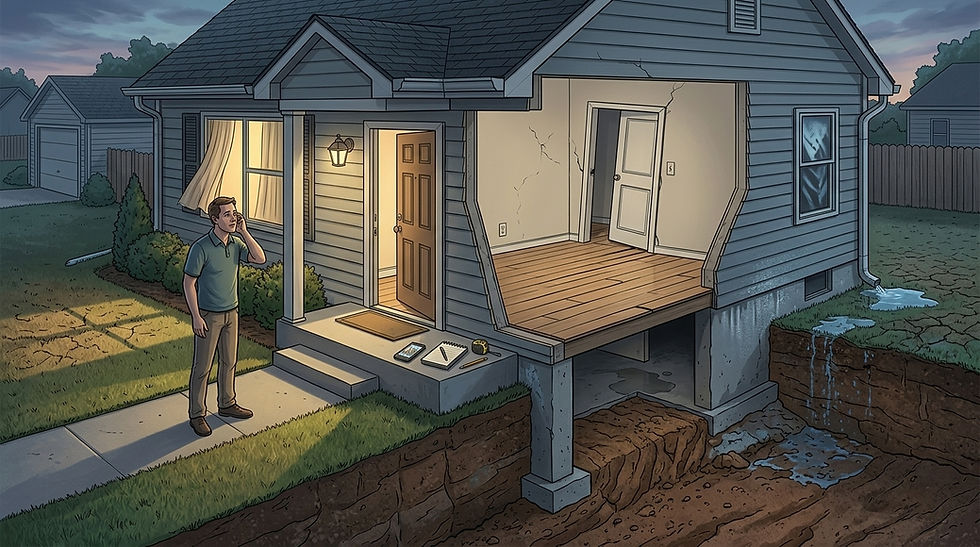
Once the work is completed, your house now has something very useful: a new baseline.
This is where all the monitoring habits we've talked about throughout this series become useful again. Keep an eye on:
- Existing cracks.
- New cracks.
- Doors and windows.
- Floor changes.
- Moisture.
- Drainage.
- Standing water.
- Crawlspace conditions.
- Soil pulling away from the foundation.
- Areas that suddenly become wetter or drier than usual.
Document changes with photographs and keep track of the dates, making simple notes if necessary whenever something changes. Knowing how the house behaves after repair can help you spot meaningful changes earlier. Think of it as learning your home’s new normal.
“When Should I Call the Contractor Back?”Don’t fall prey to paranoia. Houses will still move, make sounds, and respond to weather and seasonal changes. What matters is whether you begin seeing significant or progressive changes after the repair, for example:
- Cracks reopening or widening significantly.
- New cracks developing in repaired areas.
- Doors or windows becoming increasingly difficult to operate.
- Noticeable floor movement.
- Persistent moisture problems.
- Drainage conditions changing.
- Unexpected plumbing symptoms.
- Several warning signs appearing together.
They key word will always be patterns and that's exactly why documentation helps.
Foundation repair isn't the moment you stop paying attention to your home but the moment you begin observing it from a new baseline.
The work may be finished, but maintenance still matters. Drainage still matters. Moisture management still matters. Monitoring still matters. Preventive services may still matter too.
At iFix, we know that a foundation repair does not end with equipment leaving the driveway. Homeowners should understand what was repaired, why it was repaired, what to expect afterward and what they can do to help protect the house moving forward. The important thing is knowing what comes next.
So when the repair is finished and the credits start rolling, don’t head for the exit just yet. Stay for the post-credits scene. Your house may still have something to tell you.


Comments