
FOUNDATION REPAIRED: RED FLAG OR RECEIPT?
There are certain phrases that have the uncanny ability to change the atmosphere in a room in an instant:
‘We need to talk’, ‘Your check-engine light is on’, ‘The warranty expired yesterday’, ‘The specialist you just saw is not in-network’. Ugh, shudder. And then, when we are talking about a house there’s this: ‘It has had foundation repair.’
Cue the ominous music and the dolly-zoom shot.
But does such a phrase actually warrant this sort of reaction? For many buyers, hearing that a house has undergone foundation repair can feel like discovering a dark secret buried in its past. The immediate assumption is often that something must be terribly wrong with the property.
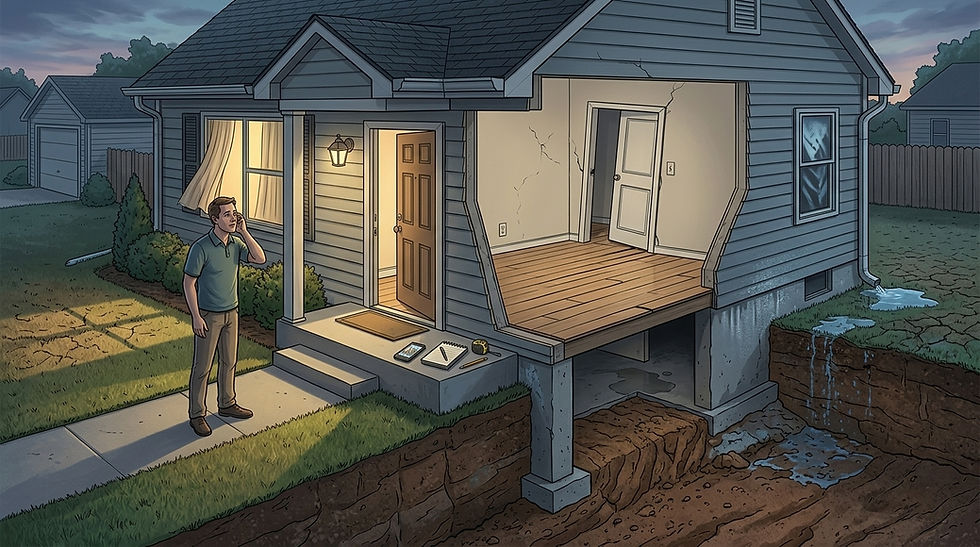
But a repair history does not automatically make a house a bad investment, or even a problematic house. In fact, sometimes the opposite can be true. A previous repair may mean a problem was identified, investigated and addressed. There may be documents showing what happened, what was done, where the repair was performed and how the house has behaved since. And that can be far more useful than walking into a house with unexplained cracks, uneven floors and absolutely no history at all.

So instead of asking if the house has ever had a foundation repair, you should ask what happened, what was done about it and what has happened since. But let’s go back and address all these concerns in their rightful order.
1. Is Foundation Repair Automatically a Red Flag?
As we discussed, not necessarily. A foundation repair tells you that something happened at some point. This is useful information; why was a repair needed? Was it localized or widespread movement? Was the underlying cause identified and addressed? Was drainage or plumbing involved? Were there any specific areas that had to be stabilized? Was the work documented? And has the house remained stable since?
A house with a documented repair history may be easier to evaluate than one with visible signs of movement and no explanation whatsoever.
2. The Paper Trail Matters
If a house has undergone foundation repair, documentation can be extremely valuable as it may include things such as:
- Inspection findings.
- Repair diagrams.
- Repair scope.
- Invoices.
- Photographs.
- Engineering information, where applicable.
- Plumbing or drainage records related to the work.
- Warranty documents.
- Follow-up inspections or service records.
You do not need a whole forensic analysis, but the more clearly the repair history is documented, the easier it becomes to understand what actually happened. Repairs with no paperwork leave buyers with lots of questions, unlike a repair with drawings, photographs, dates, invoices and follow-up records.
In other words; receipts are good, because they turn vague history into usable information.
3. Repaired Problem vs. Unexplained Problem
This distinction is important, for instance, let’s say that we have two houses side by side:
House A has documentation showing that one section experienced movement years ago, that the area was stabilized and that drainage improvements were performed afterward.
House B has several cracks, two sticking doors and an uneven floor, but nobody knows when any of it began or whether anything has ever been investigated.
While this does not mean House A is automatically the better house, it means its history gives you more to work with. A documented old repair may be much easier to evaluate than an unexplained active problem.
4. Does Foundation Repair Mean The Entire Foundation Was Bad?
No.
This is another common assumption. Foundation problems are not always uniform across an entire house. One section may move differently because of soil conditions, drainage, plumbing, tree-related moisture changes or differences in load.
That means a repair may have been designed to address a specific area rather than the entire foundation, and this is exactly why repair diagrams and inspection records are so useful.
They can help show where movement occurred, which areas were repaired, where support was added and whether other portions of the foundation were considered stable.
Hearing that ‘the house had foundation repair’ without knowing the scope could mean almost anything. The details matter.
5. If You Are A Buyer, What Should You Look For?
If you are considering buying a home with a repair history, do not panic, but do pay attention.
You have to look at the house as it exists now. Check to see if there are any current cracks, or old ones that are now reopening. Check how windows and doors operate and if the floors are consistent. Check for any signs of standing water near the foundations, and how the downspouts discharge. Look at whether grading directs water appropriately away from the foundation, and look for signs of moisture problems. Look at the landscaping and try to notice any changes. Make sure there is no evidence of plumbing issues and ask yourself if there is something that appears to be changing.
A repaired area that has remained stable tells you something about the work that was done, and it is a whole different story from the one where the symptoms are actively returning.
This is where a professional inspection can be useful; not merely to confirm that repairs were performed, but because you are trying to understand how the house is behaving today.
6. If You Are A Seller, What Should You Do?
If you are selling a house that has undergone foundation repair, treating the repair like something that needs to be hidden is not a useful approach. Instead, you organize what you know; keep the documents together and understand what work was performed and where. Have the warranty information available, and keep records of any related drainage, plumbing or moisture-management work, as well as follow-up inspections.
You don’t need to become an expert in foundations, but being able to explain the repair history clearly will make a big difference when trying to sell your home.
7. What About the Warranty?
A warranty can be useful, but it is not a magic spell. Both the buyer and the seller should understand what the warranty actually covers: what are the obligations? Is it transferable? What is included or excluded? etc. A warranty on one repaired section does not necessarily mean the entire foundation is covered forever.
Ask whatever questions you have and read it thoroughly so you can be well informed.
8. Can Foundation Problems Come Back?
A repaired foundation does not suddenly get its own shield generator on the forest moon of Endor. The house still sits on soil and is still exposed to weather changes, plumbing issues and changing drainage conditions. Not to mention that movement could potentially develop in another area that was not part of the original repair.
This is why the conditions around the house remain important even after stabilization. If poor drainage contributed to the original problem and the drainage was never corrected, then the environmental conditions that helped create the movement may still be present.
The structural repair may have addressed the consequence, but the cause may still need attention. And this is why buyers should look beyond the piers and look at the yard, the water, the downspouts, the grading and the plumbing system. Remember that the foundation is only one part of the whole system.
9. A Repaired Foundation Is Not a Time Machine
We talked about this in our previous article, but it bears repeating here. Foundation repair does not return a house to the exact condition it occupied the day it was built.
There may still be cosmetic cracks, slight imperfections or adjustments that need attention. so a buyer should not expect an older repaired home to suddenly behave like a brand-new structure rolling off the assembly line.
What matters is whether the repaired areas are stable and whether the house is currently performing as expected.
10. Don’t Fear the Label.
There is a big difference between a house that has had a foundation repair and one that has an unresolved foundation problem. Those two things are not interchangeable. A documented repair gives you information. An inspection gives you context. And monitoring will tell you whether the conditions remain stable.
That is why the most useful question is not if a house has ever had a foundation repair, but to ask what happened, what was done and what has happened since.
At iFix, knowledge comes before the sale. Our goal is to help homeowners, buyers and sellers understand what they are actually looking at so they can make informed decisions about what, if anything, needs to be done.


Comments